
- Home
- Treatments
- PRP for hair loss
Hair
PRP hair treatment in Vehari
Your own platelet-rich plasma injected into the scalp to support thinning areas — used alongside a medical plan, because PRP on its own rarely holds a result.
What it is
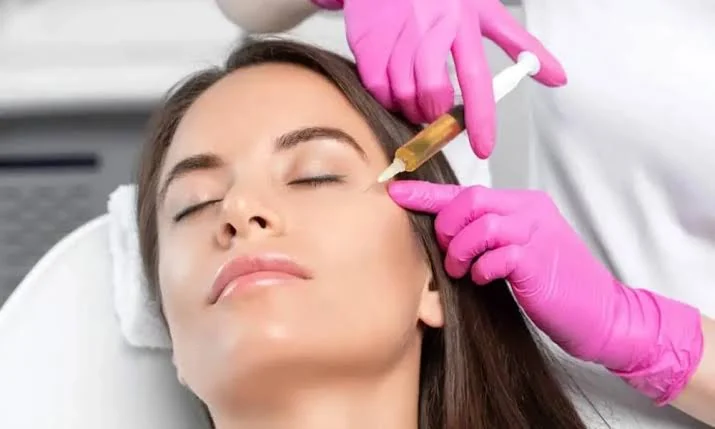
PRP starts with your own blood. A small sample is drawn, spun in a centrifuge to separate and concentrate the platelets, and that concentrate is injected across the thinning area of the scalp. Platelets carry growth factors, and the intention is to prolong the growth phase of follicles that are still alive but producing progressively finer hair.
The important word there is alive. PRP can support a struggling follicle. It cannot regrow hair where the follicle is gone, which is why a bald, shiny scalp does not respond and diffuse thinning often does.
Here is the part most places skip: hair loss has causes, and finding them changes the outcome more than the injection does. Low ferritin, an underactive thyroid, vitamin D deficiency, PCOS, recent illness, crash dieting, post-pregnancy shedding and androgenetic pattern loss all present as thinning and are managed differently. We arrange blood work before starting a course, because injecting plasma into a scalp while an untreated iron deficiency continues is money spent on a result that will unwind.
Benefits
- Uses your own blood, so no risk of allergic reaction to a foreign substance
- Can slow shedding and thicken existing hair in the treated area
- No general anaesthetic, no surgery, no lasting downtime
- Blood work included, so a treatable underlying cause is not missed
- Works alongside topical or oral treatment for a better combined result
- Suitable for both women and men with diffuse thinning
Who it suits — and who it doesn't
A good candidate if…
- You have diffuse thinning, a widening part or reducing density
- You still have fine hair in the affected area rather than smooth bald scalp
- You are willing to have blood tests and treat any cause found
- You can commit to four to six monthly sessions plus maintenance
Not suitable, or postponed, if…
- You have completely bald areas with no follicles remaining
- You have a bleeding disorder, low platelet count, or take blood thinners
- You have an active scalp infection or folliculitis
- You are pregnant or breastfeeding
- You have an untreated thyroid or iron problem — we treat that first, then reassess
- You are on chemotherapy or have an active blood disorder
This list is not exhaustive. Your medical history, medications and previous treatments are reviewed at consultation, and that review sometimes changes the plan.
The procedure, step by step
- Consultation and blood work. History, scalp examination and pattern assessment, then tests including ferritin, thyroid function, vitamin D and, where relevant, hormonal profile.
- Reviewing results. If a cause is found we treat it. Sometimes that alone improves the hair enough that a PRP course can be deferred or shortened.
- Blood draw. A small sample is taken from your arm, the same as any blood test.
- Centrifuge. The sample is spun to separate and concentrate the platelet-rich layer. This takes about ten minutes and happens in the room.
- Injection. The plasma is injected across the scalp in a grid pattern at follicle depth, using a very fine needle. It stings briefly at each point; most patients describe it as uncomfortable rather than painful.
- Plan and review. Monthly sessions, standardised photographs each visit, and a topical or oral plan running alongside. Density is reviewed at three and six months.
Recovery and aftercare
The scalp feels tender and slightly tight for the rest of the day, occasionally into the next. Mild swelling of the forehead can occur overnight and settles.
Do not wash your hair for 24 hours. Avoid hair colour, chemical straightening and strong styling products for a week. Avoid the gym, steam and swimming for 48 hours. Avoid painkillers of the anti-inflammatory type just before and after sessions, as they can interfere with the platelet response — paracetamol is fine.
Expect a small amount of extra shedding in the first two to three weeks. This is normal, it is the old hairs releasing, and it settles.
Results you can expect
Nothing visible happens for the first two months. Reduced shedding usually comes first, around six to ten weeks. Visible thickening is typically judged at three to four months, and the fullest result at six.
PRP maintains and thickens; it does not create new follicles. Androgenetic hair loss is progressive, so results need maintenance sessions every four to six months and a continuing medical plan. If you stop everything, thinning resumes on its usual course.
Response varies. Some patients gain noticeably; a minority see little change, and we would rather tell you at three months that it is not working for you than sell you a fifth session.
Pricing. Priced per session, with course pricing for four to six. Blood work is charged separately by the laboratory. Exact cost is confirmed at consultation once we know how large an area needs treating.
Frequently asked questions
Is PRP painful?
The blood draw is a normal needle prick. The scalp injections sting for a second each, and the front hairline is the most sensitive part. Most patients manage without numbing, and we can apply topical anaesthetic if you would prefer it.
How many PRP sessions will I need?
Usually four to six sessions one month apart, then maintenance every four to six months. That schedule is confirmed after your scalp is examined and your blood results are back.
Will PRP regrow hair on a bald patch?
No. PRP supports follicles that are still present but weakening. Where the scalp is smooth and the follicles are gone, PRP will not bring them back — a hair transplant is the option in that situation.
Why do you insist on blood tests first?
Because in a large share of patients, particularly women, thinning is driven by low ferritin, thyroid dysfunction or vitamin D deficiency. Treating that changes the hair. Injecting PRP while the cause continues wastes your money.
Is PRP safe?
It uses your own blood, so there is no risk of rejection or allergy to the product itself. Risks are those of any injection: soreness, bruising, swelling, and rarely infection. It is avoided in bleeding disorders, low platelets and pregnancy.
Can men and women both have PRP?
Yes. Male pattern loss and female diffuse thinning are both treated, though the pattern and the accompanying medical plan differ.
Do I need to keep having it forever?
If your hair loss is the progressive androgenetic type, then yes, maintenance is part of it — the same as it is with any treatment for a progressive condition. If the cause was reversible, such as iron deficiency or post-pregnancy shedding, you may not need ongoing sessions once it is corrected.
Written and medically reviewed by Dr. Bareera Usman, MBBS
Last reviewed: July 2026. This page is general information, not a diagnosis or a treatment plan for any individual.
Next step
Find out why your hair is thinning
Start with a consultation and blood work. Knowing the cause changes what treatment is worth doing — and sometimes means you need less than you expected.
Near Gymkhana, VehariMon–Sat, 1:00 PM – 8:00 PM · 0302-1436060